Sovereign by Design: Where Your Data Lives Is Now an AI Infrastructure Decision
For years, data sovereignty was a box on a procurement form — a jurisdiction clause, a compliance sign-off, a line in a data processing agreement. That is changing. As enterprises move AI workloads out of the lab and into production, where data physically lives has become an infrastructure architecture decision, not a legal footnote.
The question is no longer simply ’are we compliant?‘ It is ’do we actually control the data our AI depends on — where it is stored, who can access it, and which infrastructure and software it runs on?‘ For a growing number of organizations, answering that question is bringing them back to infrastructure they own and operate.
Sovereignty shift made concrete
November 2026 brought the shift into sharper focus. Teradata’s expanded sovereign AI capabilities across on-premises and air-gapped environments highlighted a growing market requirement. Citing a 2026 BARC study, Teradata reported that 62% of decision-makers identify data and AI in core business processes as a driver of sovereignty requirements. Gartner forecasts that more than 75% of enterprises outside the US will have a digital sovereignty strategy by 2030.
A survey reported by CIO the following day added another dimension. Research from Intersect360 found that 68.2% of HPC and AI practitioners use no public cloud storage for their active workloads, 83.5% believe data and compute must remain physically close, and 92.9% consider storage strategically important rather than a commodity purchase.
Two forces are converging behind these findings: data gravity and data sovereignty. AI workloads generate and consume enormous volumes of data. Moving petabytes into external cloud environments, paying to store and access them, and managing the associated dependencies becomes increasingly difficult to justify when both the data and the operational control need to remain within the organisation’s boundaries.
On-premises is the foundation, not the fallback
It is tempting to interpret this as a return to traditional infrastructure — a retreat to the server room. In reality, it represents a different kind of architectural choice.
For data-intensive AI, on-premises infrastructure is increasingly a strategic decision rather than a legacy constraint. Keeping data and compute together reduces data movement, avoids cloud egress costs and gives organisations greater control over access, security and operational continuity.
At multi-petabyte scale, owning and operating infrastructure can also offer a more predictable long-term cost model than renting capacity indefinitely.
National research institutions, public broadcasters, archives and AI infrastructure providers already manage data estates at this scale. For them, sovereignty is not an abstract policy objective. It is about maintaining control over critical data, infrastructure and the conditions under which they operate.
Sovereignty has to extend to the storage layer
Sovereign AI is only as sovereign as the infrastructure supporting it. Repatriating compute is not enough if the storage underneath remains a black box — tied to a single vendor, dependent on proprietary software or operated under terms the organisation cannot independently control.
That makes storage architecture a sovereignty consideration in its own right.
Can you audit the software? Who controls the encryption keys? Can you deploy it on hardware you own, in a location you choose, under a legal and operational framework you control? Can you continue operating without depending on an external provider?
These are increasingly important questions when designing infrastructure for long-term AI workloads.
Leil approaches this challenge through an HDD-native, software-defined architecture built for large-scale on-premises environments. The objective is not simply to keep data on-premises, but to make doing so economically sustainable.
As co-founder and CEO Aleksandr Ragel puts it, ”Storage value is defined by how efficiently data can be stored without compromising performance — not by the number of drives deployed.”
This is where storage efficiency becomes part of the sovereignty equation. Leil OS, Leil’s commercial storage platform for large-scale on-premises environments, unlocks over 20% more usable capacity per drive through native Host-Managed SMR support, while its Infinite Cold Engine (ICE) technology can reduce storage-tier electricity consumption by up to 70% by physically powering down idle drives.
The result is greater capacity and lower operating costs from infrastructure organisations already own – making long-term, customer-controlled data storage a more viable economic proposition.
What sovereign by design looks like: 92/100
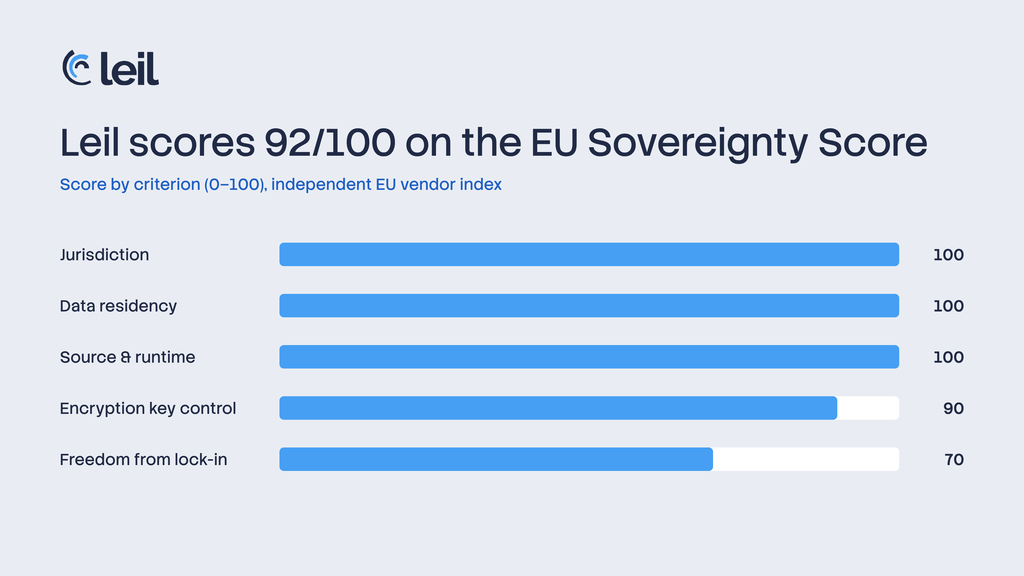
These principles can also be assessed. On the EU Sovereignty Score, an independent index evaluating the degree of control software vendors leave with their customers, Leil scores 92 out of 100.
The breakdown highlights the foundations of that result.
Leil receives full marks for jurisdiction (100) and data residency (100). Headquartered in Estonia, Leil operates under EU jurisdiction, while its self-hosted architecture allows customers to determine where their data resides.
Cryptographic key sovereignty scores 90, reflecting the customer’s ability to retain control of encryption keys. Source and runtime sovereignty receives 100: the software runs entirely on infrastructure the customer controls and can be independently audited, without dependence on a proprietary black box.
The remaining gap is freedom from lock-in (70). Leil OS is a separate, commercially licensed product built for enterprise production deployments. Organisations already running Leil FS (a free community edition for self-supported deployments) can upgrade to Leil OS without migrating their data, so the move to a fully supported platform doesn’t put existing data at risk.
The score is not a substitute for assessing an organisation’s entire technology stack. It does, however, offer an independent indication of the control available at the storage layer.
As Ragel describes Leil’s purpose, the aim is “making hyperscale storage economics a reality for every enterprise… ensuring critical data remains under our customers’ control.”
The takeaway
Sovereignty is no longer something organisations can bolt on once their infrastructure architecture is established. It needs to be designed in from the beginning — through decisions about where data lives, who holds the keys, which software runs it and who ultimately controls the infrastructure.
For AI at scale, that increasingly means investing in infrastructure that organisations can own and operate themselves, supported by storage that is efficient enough to make it sustainable and open enough to retain control.
Sovereign by design, not by exception.
For a broader discussion of this dimension, see Leil’s coverage of Data Sovereignty in the AI Era Panel Discussion at Storage Days Tallinn.
Sources:
- EU Sovereignty Score — Leil
- Teradata Expands Sovereign AI Across On-Premises and Air-Gapped Cloud Environments – StorageNewsletter, November 2026 (official announcement: October 20, 2026)
- Data sovereignty is reshaping AI infrastructure – CIO / HPE and AMD BrandPost, November 10, 2026 (Intersect360 Research)
Author: Alexander Ragel
Alexander Ragel is the CEO of Leil Storage, an Estonia-based storage infrastructure company building HDD-native software for the exabyte era. Leil is in active co-engineering partnership with Western Digital, validated across the WD, Seagate, and Toshiba drive ecosystems.

